Services
SERVICES
SOLUTIONS
TECHNOLOGIES
Industries
Insights
TRENDING TOPICS
INDUSTRY-RELATED TOPICS
OUR EXPERTS

September 17, 2026

Smart manufacturing is a data-driven approach that entails the integration of advanced technologies such as AI-based analytics, IIoT, computer vision, robotics, and digital twins into traditional manufacturing processes that help companies improve decision-making and optimize production operations.
In recent years, the manufacturing industry has seen a significant uptick in the adoption of digital tools and technologies that have propelled the innovation and growth of smart manufacturing. Currently, smart manufacturing is garnering a lot of attention from manufacturers, as it promises to streamline production processes, increase operational efficiency, and improve companies’ adaptability to evolving business and market demands. In light of this, the role of professional AI service providers becomes critical for ensuring seamless integration of smart manufacturing technologies into organizations’ technical ecosystems and business workflows.
To achieve smart manufacturing, factories implement a set of advanced technologies, connecting equipment, systems, and people and facilitating real-time data collection and analysis for improved decision-making. Fundamental technological advancements include industrial IoT, manufacturing execution systems, AI-powered analytics, computer vision, and digital twins, with complementary smart manufacturing technologies being cloud computing, edge computing, AR/VR, and 3D printing (or additive manufacturing).

Being a foundational enabler of smart manufacturing, IIoT implies the use of interconnected smart sensors, actuators, and machinery that capture real-time data on equipment temperature, vibration, performance, energy consumption, and status, which is then used for analysis.
By connecting data from multiple sources, including IoT sensors and devices, manufacturing ERP software, product lifecycle management systems, and supply chain management platforms, an MES helps track, document, and control manufacturing processes. While IIoT helps understand what happened on the shop floor, the MES helps determine what it means for production.
Analytics solutions powered by AI algorithms process big data volumes from diverse sources, turning raw data into actionable insights. By relying on statistical modeling, data mining techniques, and machine learning, such tools can uncover hidden patterns in the data, predict product defects and equipment failure, and identify the root causes behind them.
Computer vision systems process data from cameras installed on production lines, monitoring the assembly process, checking product labeling, looking for product defects, and detecting equipment performance deviations from established standards in real-time. By using insights from these systems, inspectors and technicians can prevent nonconforming products from reaching customers and reduce equipment downtime thanks to timely maintenance.
Industrial robots operate autonomously, completing repetitive and dangerous tasks, such as welding and assembly, faster and with greater precision than humans. Working alongside human operators or autonomously, robots help improve workplace safety, operational efficiency, and product quality.
Digital twins represent virtual replicas of machines, production lines, products, or entire factories, used to simulate and optimize physical assets, production operations, and supply chain processes, as well as test and validate new product designs before implementing changes in the real world. These replicas help manufacturers evaluate the impact of increasing line speed, determine whether current production capacity is sufficient to fulfill an order, and assess how new process settings can affect product quality.

To help an automotive supplier prevent material flow disruptions caused by wear in material handling systems, our team implemented an AI-powered predictive maintenance solution. This solution analyzes asset condition data and maintenance records, detecting early signs of wear and estimating the probability of equipment failure or the remaining useful life of specific components, such as drives, gearboxes, bearing assemblies, or conveyor segments.
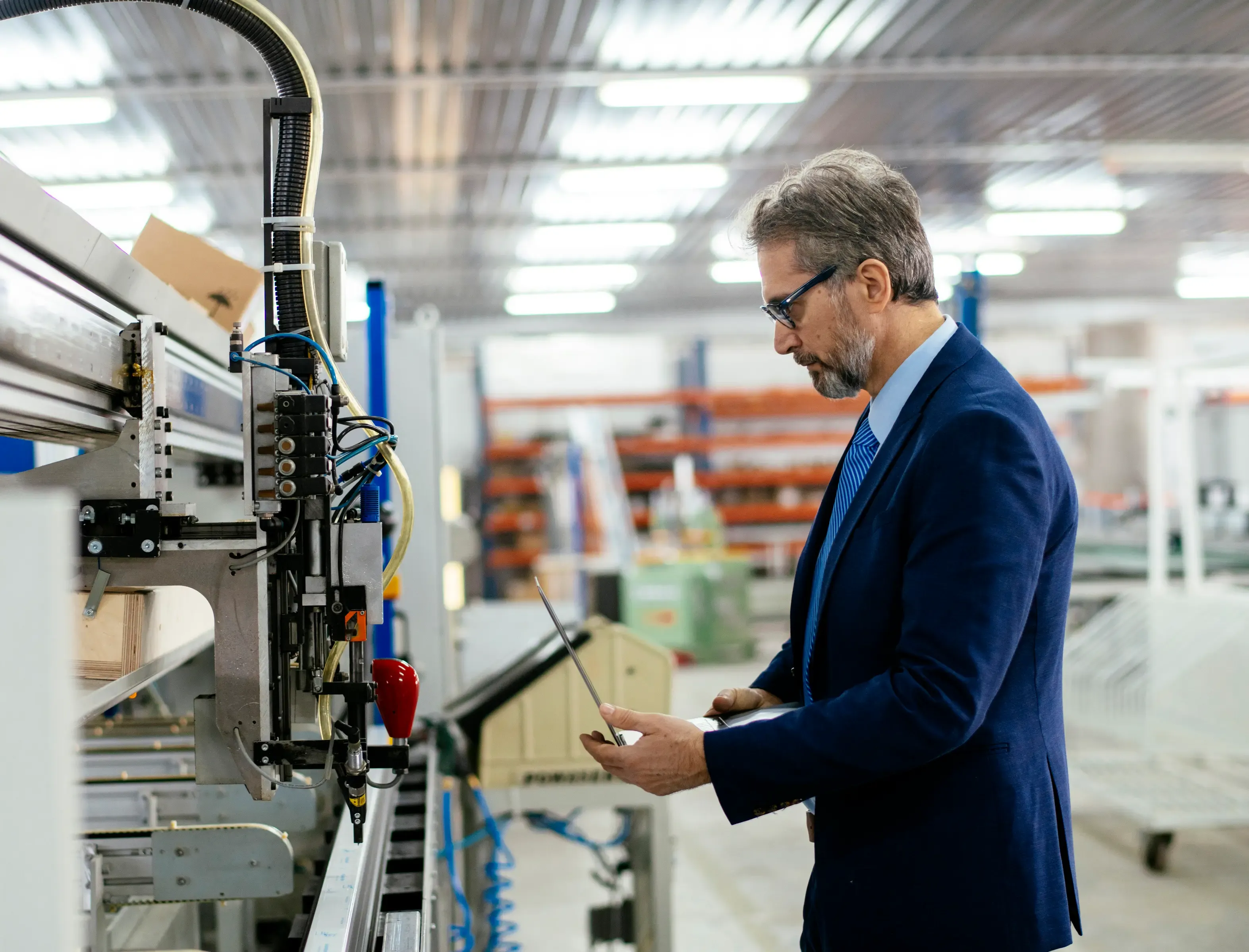
We helped an automotive supplier shift from reactive repairs to proactive maintenance, delivering a solution that detects early signs of equipment degradation. Analyzing equipment performance signals from sensors and PLCs, the solution distinguishes between normal process variations and emerging machine issues, enabling the customer to better plan equipment maintenance activities.

To help a US-based manufacturer automatically conduct consistent, comprehensive product inspection and comply with their end-clients’ quality standards, we delivered a computer vision solution powered by neural networks. The tool analyzes images of medical containers and assesses coating coverage and thickness, determining whether the product is defective.

Our experts provided strategic and technical guidance on implementing AI to streamline production operations at a US-based hardwood veneer and plywood panel factory. As part of the engagement, we conceptualized and delivered an AI-powered solution that detects different flaws on plywood surfaces, classifies plywood sheets by quality grade, and routes them to corresponding storage destinations.
Smart manufacturing solutions bring a number of benefits, helping manufacturing teams streamline production workflows, reduce operational costs, and improve decision-making. Itransition helps manufacturers identify a priority use case for smart manufacturing technologies and ensure their seamless implementation, allowing businesses to capitalize on smart manufacturing advantages.
By automating manufacturing operations and using data-driven insights, supervisors and engineers can prevent asset downtime, improve overall equipment efficiency, and reduce production cycle times.
By minimizing human errors, production disruptions, product quality issues, and material waste, smart manufacturing solutions help manufacturing companies reduce operational costs while maintaining high production throughput and consistent product quality.
With complete visibility across the supply chain and manufacturing processes, as well as predictive insights, manufacturers can quickly adapt to changes in consumer demand, raw material and logistics costs, and production requirements.
By leveraging smart manufacturing technologies, manufacturing companies can collect comprehensive data from MES, ERP, PLCs, and sensors and analyze it to gain real-time visibility into operations, identify root causes of bottlenecks in the production line and equipment malfunctions, and make informed decisions.
Manufacturers can rely on smart manufacturing technologies to optimize machine parameters, maintenance schedules, and equipment usage to reduce energy consumption, prevent product defects and scrap, and extend equipment lifespan, minimizing their carbon footprint.
As shown by market research, manufacturers are actively investing in smart manufacturing technologies, with the global smart manufacturing market expected to grow by 82% from 2025 to 2029. Here are the main insights into the smart manufacturing market and smart manufacturing adoption benefits and challenges.
| The global smart manufacturing market is expected to grow by 82% from $263.22 billion in 2025 to $479.17 billion in 2029. | |
|---|---|
| The global smart manufacturing market is forecasted to expand at a CAGR of 14.7% from 2026 to 2034. | |
| With the largest revenue share of more than 46%, Asia Pacific led the worldwide smart manufacturing market in 2025. | |
| By component, the software segment dominated the smart manufacturing market with the largest revenue share of over 50% in 2025. | |
| With the largest revenue share of more than 19%, the automotive segment dominated the smart manufacturing market by end use in 2025. |
Image title: Top smart manufacturing technology & software providers
Data source: MarketsandMarkets
| More than three-quarters of manufacturers allocate more than 20% of their overall improvement budget toward smart manufacturing initiatives. | |
|---|---|
| According to 88% of survey respondents, investments in smart manufacturing will either continue or rise in the upcoming fiscal year. | |
| 59% of manufacturing leaders already use smart manufacturing technologies, while only 18% are piloting smart manufacturing solutions. | |
| Manufacturers are now focusing their efforts on automating repetitive tasks (73%), enhancing planning and scheduling (65%) , and implementing AI (64%) as the primary sources of productivity. | |
| 50% of German manufacturers have already invested in AI, with 47% planning further deployment. | |
| 38% of German manufacturers have deployed digital twins, and 37% plan to invest in this technology. | |
| 81% of manufacturing executives surveyed said they intend to invest more in AI over the next three years, and 93% believe intelligent systems will be essential to America's industrial advantage. |
Scheme title: Smart manufacturing technologies & solutions as priority investments
Data source: Deloitte
Scheme title: Top priorities for autonomous factory investment
Data source: PwC
Scheme title: Top priorities for data intelligence investment
Data source: PwC
Scheme title: Smart manufacturing market breakdown by technology
Data source: Grand View Research
| According to 92% of manufacturers surveyed, smart manufacturing will be the primary source of competitiveness in the upcoming three years. | |
|---|---|
| According to 85% of survey respondents, they expect smart manufacturing solutions to enhance business agility, change the way products are manufactured, and draw in new manufacturing talent. | |
| For 49% of manufacturing executives, operational improvements represent the primary value of smart manufacturing, with 44% citing financial benefits as the second-highest priority. | |
| Manufacturers reported an average improvement of 10% to 20% in production output, 7% to 20% in personnel productivity, and 10% to 15% in unlocked capacity following smart manufacturing implementation. | |
| By 2030, about 70% of industrial companies anticipate that AI will boost their operating margin by at least three points, and over 40% expect an even greater rise of five points or more. | |
| Approximately one-third of businesses that use AI report that it has improved decision-making, and more claim that their business has improved operational efficiency and flexibility. | |
| According to research, 96% of manufacturers have improved operational efficiency, and 62% report a return on investment of more than 10% thanks to AI. | |
| 54% of manufacturing organizations report realizing over 20% in cost savings from advanced digital technologies, with AI, cloud computing, 5G, edge computing, and digital twins identified as top investment priorities for reindustrialization. |
| 35% of survey respondents cited workforce adaptation to the "Factory of the Future" as a leading concern, including the need to equip employees with the skills and tools required to realize the full value of smart manufacturing. | |
|---|---|
| 48% of manufacturers plan to reallocate or hire more workers due to smart manufacturing investments. | |
| 42% of employees across German factories participate in reskilling programs to keep up with smart manufacturing adoption. | |
| 46% of manufacturers faced at least one cyberattack in the previous 12 months, testifying to increasing cybersecurity risks as operations become more connected and autonomous. |
Itransition provides a broad range of services to help manufacturers integrate smart manufacturing technologies based on their business needs and goals.

Our team develops diverse AI-driven solutions, including computer vision systems, analytical software, and AI agents for manufacturing, to streamline complex, multi-step processes, analyze large-scale data, and reduce manual effort. We implement solutions that process heterogeneous data faster and more accurately than humans, generate predictions and natural language recommendations for manufacturing teams, and act autonomously.
We help manufacturers derive insights from high-volume data generated by IoT sensors and business systems, providing data analytics consulting and implementation services. Our experts deliver solutions that support advanced analytics, making predictions and generating recommendations for manufacturing teams to make data-driven decisions.
We provide industrial IoT consulting and software development services to help manufacturers identify the feasibility of IIoT implementation in their plants and ensure smooth technology integration into their IT ecosystem and business workflows. Our experts develop web and mobile IoT applications, customize out-of-the-box IoT platforms, and create IoT-enabled industrial digital twins and IoT data analytics solutions, facilitating the collection, exchange, and analysis of data from industrial assets.
Our team of developers delivers computer vision solutions for manufacturing that analyze raw visual data and provide actionable insights into product quality, equipment performance, workplace safety, or inventory levels. Having vast expertise in implementing computer vision technologies, we help manufacturers automate visual inspections, eliminate human error, and maximize production throughput.
We expand manufacturers’ technology ecosystems with software solutions that help streamline production, supply chain, financial, sales, and human resources management, as well as marketing and customer support processes. We tailor the solutions to the existing manufacturing workflows and end-user needs, equipping them with the required functionality and advanced technologies.
Providing IT consulting and software engineering services since 1998
In-house AI/ML Center of Excellence and R&D labs for centralizing and expanding AI expertise
Long-running partnerships with Microsoft and AWS
Holding a Microsoft Azure AI Platform specialization
Compliance with ISO 9001 and ISO 27001 for quality and information security management
Awards and recognitions from Gartner, Deloitte, Forrester Research, and Everest Group
4.9 average rating on Clutch
Companies across the manufacturing industry operate in a complex environment shaped by economic pressures, skilled labor shortages, supply chain challenges, and environmental concerns. With continuous advancements in AI, IoT, and robotics, manufacturers that adopt digital transformation can remain competitive, resilient, and scalable.
To avoid disruptions to current operations when implementing smart manufacturing systems, technical expertise and a well-planned approach to integrating new technologies are essential. Itransition provides comprehensive services to help manufacturers digitize their processes, while ensuring regulatory compliance and maximizing user adoption.
Smart manufacturing entails the use of advanced technologies, such as AI, IIoT, cloud computing, and robotics, and focuses on connectivity among machines, automation, real-time data collection, and data analysis. Smart manufacturing technologies help manufacturers optimize production processes to improve operational efficiency, profitability, and resilience.
The Fourth Industrial Revolution, also known as Industry 4.0, is defined by growing automation, connectivity among machines, and the use of technologies like industrial IoT, AI, big data analytics, robotics, and augmented reality to create smart factories. Industry 4.0 emphasizes improving efficiency and productivity throughout the whole value chain. The concept is now being replaced by Industry 5.0, where the main focus is on worker well-being, environmental sustainability, and societal impact rather than pure automation and digitalization.
Depending on the technology implemented, manufacturers can use smart manufacturing solutions for predictive maintenance, quality control, product development, large-scale data analysis, production process optimization, and workforce training.
Common challenges in adopting smart manufacturing include high initial capital investment, the complexity of integrating the solution with legacy systems, increased cybersecurity risks, and skill gaps. At Itransition, we help businesses handle these problems, optimizing project costs and ensuring cross-system interoperability, data security, and user adoption.

Insights
Learn how machine learning transforms manufacturing based on popular use cases and real-world examples, helping boost production efficiency and output quality.
Insights
Discover how IoT can help manufacturers optimize supply chains, energy management, enhance inventory management, improve product performance, and boost revenue.

Insights
Learn how predictive analytics in manufacturing helps companies move from reactive to proactive decision-making and explore top predictive analytics software.

Service
Learn how to use business intelligence for manufacturing and explore BI software capabilities, along with implementation challenges and how to handle them.

Insights
Explore the use cases and benefits of computer vision in manufacturing, along with implementation challenges and practical tips for smooth technology adoption.

Service
Professional IoT development services to deliver IoT solutions that efficiently manage the network of connected devices and generate real-time insights.
Services
Industries